I remember that things are always changing. They change to larger, newer, and sometimes better. There was a time when my life was a lot different. Let’s travel down a street in Chicago called Lawrence Avenue. The year is 1935.
At the start of the block was Lew’s Pool Hall. Inside there were five pool tables and one billiard table. Renting one of the tables cost fifty cents an hour.
Next there was a shoe store featuring Buster Brown shoes. You could stand on an x-ray machine and see the bones of your feet. No one knew, at the time, that it was dangerous.
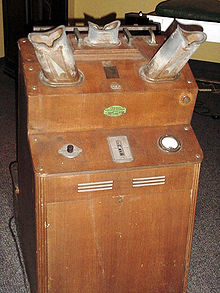
(Shoe Fluoroscope on display at the National Museum of Health and Medicine, manufactured by Adrian Shoe Fitter, Inc. circa 1938, that was used in a Washington, DC Shoe Store.)
(The shoe fitting fluoroscope was a common fixture in shoe stores during the 1930s, 1940s and early 1950s. A typical unit, like the Adrian machine shown here, consisted of a vertical wooden cabinet with an opening near the bottom into which the feet were placed. When you looked through one of the three viewing ports on the top of the cabinet (e.g., one for the child being fitted, one for the child’s mother, and the third for the shoe salesman), you would see a fluorescent image of the bones of the feet and the outline of the shoes. These machines were outlawed when the danger from the radiation they emitted was understood.)
Then there was the Tailor Shop also known as the local cleaners and dyers. The tailor could make you a suit or repair your clothing. To have a suit cleaned and pressed cost fifty cents. Dress shirts cost twenty-five cents with a choice of on or off a hanger. The place always smelled of cleaning fluid.
At the local grocery store you could tell the clerk (usually the owner) what food item you wished to buy. He would then take it off the shelf, put it in a paper bag and tell you the total price. Silver Cup white bread sold for fifteen cents a loaf. When the grocer bought new stock, he would pay the vendor in cash. He would write down his purchases on butcher paper. At the end of the month, the bookkeeper would take it off the spindle and tally it.
The barbershop had an aroma all its own. To me, it smelled like vitalis hair tonic. The shop contained three chairs and a sign that said “no waiting”. In front of the shop was a striped barber pole. A hair cut cost fifty cents and for an extra thirty-five cents it would include a shave. The shop also offered shoeshines for twenty-five cents. For one dollar and fifteen cents, you could feel like a king at that barbershop. It wasn’t until the forties that hair cuts went up to seventy-five cents.
When you walked into the Deli on Lawrence Avenue, the smell was heavenly and overwhelming. The Deli gave off an aroma from the pickles, sauerkraut, and green tomatoes, all in barrels. I still yearn for a new dill pickle! Behind the counter, the owner wore a white apron, but it never seemed to be all white. Behind the counter were huge salamis, a slicing machine, large piles of corned-beef and pastrami. If you wanted mustard with your takeout order, he would fold some butcher paper into the shape of a cone and pour in the mustard. The house special was an egg cream drink that was a mixture of cream, chocolate, and seltzer.
Moving on down the street was the Butcher Shop. The shop consisted of a large meat counter, wood chopping block, a meat saw, and several sharp knives. In back of the worktable was a large meat cooler. The floor was covered with sawdust. I often wondered if his thumb somehow found its way onto the scale. I grew up thinking that all meat and chicken could only be boiled. One day I found out there was such a thing called fried foods.
In the Fish Store, there was a large counter loaded with fresh fish sitting on a bed of chopped ice. When you told him what you wished to buy, he would scale and cut the fish to order. Then he would wrap it in newspaper.
One of the stores I never went into was a Corset Shop. I can’t say much about it, but the display windows were covered with various styles of corsets.
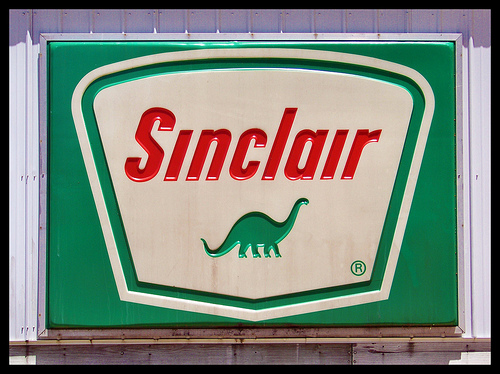
On the corner was a Sinclair Gas Station. There were two pumps. One was for regular and one was for super. The gas contained lead and was called ethyl. When you drove into the station, your auto would go over a rubber tube that would ring a bell inside telling the attendant you needed service. He would put the gas in your car, check your oil, put air in the tires, and clean your windshield—all for eighteen cents a gallon of gas. In front of the station was a picture of a large dinosaur.
Lawrence Avenue even had its own bookie! The place was called a card room. The game they played was gin rummy. It was a two-person game. The house would charge for use of the tables. You could place a bet on any sports event and horse races. The information would come in over a ticker tape. There were all types of people that frequented the card room. One of the characters was Overcoat Charley. If you needed a coat for a fee, he would find one for you. Just tell him the style, color, and size. The place never got raided. I always wondered why.
The Terminal Theater was the place for movies. There was a large sign on the marquee that said it was air-conditioned. On a hot summer day, it was the place to be. The first movie I remember was Cinderella. The Theater had a balcony where you could smoke in a special section. You could see a double feature, newsreel, cartoon, and coming attractions all for fifty cents. Children were admitted for twenty-five cents. On the weekend, they would feature children’s programs during the early part of the day. The serial suspense would go on forever. Each week you would have to return to see what happened. It was the baby-sitter of the times.
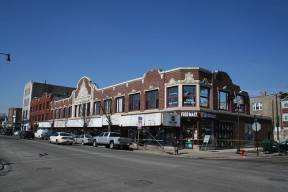
“The Terminal Theatre, one of the largest movie houses built in Chicago’s Albany Park neighborhood, opened in 1925, replacing the Ascher Brother’s earlier (1915) theater of the same name, which became the Metro after the new Terminal opened. Seating well over 2000, the Terminal was acquired from the Aschers not long after by the always-expanding Balaban & Katz chain, which ran this popular movie house into the 60s. The theater was demolished in the early 70s.” Source
I often wonder if there are still places operating such as the Chicken Store on Lawrence Avenue? There were many cages filled with large chickens. You made your selection and a man would take the chicken out of the cage, fold its wings, and then humanely kill it. He would pull out the feathers and then put it over a gas fire to rid it of pinfeathers. The chicken was then wrapped in brown butcher paper and your sale was over.
The Bowling Alley had twelve lanes. There were people who were pinsetters behind each lane. It wasn’t until the early forties that automatic pinsetters were installed. The cost was thirty-five cents per lane and shoes cost fifteen cents to rent. The afternoons and weekends were mostly for league bowling. All other times were called open bowling. A large part of their income came from the bar that was part of the Bowling Alley.
In the Center of Lawrence Avenue were electric car tracks for the streetcars. For seven cents you could ride for miles. The cars were painted red with a motorman in front and a conductor in the rear. The electricity came from an overhead line. The El Train was an elevated train ran from Lawrence Avenue to the Chicago Loop. The cost was ten cents.
The front section of the Drug Store had an ice cream soda bar. They specialized in hot fudge sundaes, sodas, and Cokes laced with lemon, cherry, or any flavor you might want. This was all for five cents. The malted milk was thick and made with real ice cream. The center of the drug store was stocked with general merchandise and the druggist was in the rear of the store. In front of the Drug Store was a U.S. Mail Box where kids would hang out. That is where the name Drugstore Cowboys came from.
Still another store was a Shoe Repair Shop. There were rows of shoes to be repaired and some finished that were sitting on a shelf. To keep the cost down, most people would order half soles. People would repair their shoes several times until the upper parts of the shoe would fall apart. The odor of tanned leather and rubber cement was always present.
If you had a problem with your coffee maker, toaster, Mixmaster, or other small appliance, you could take it to the Fix It Shop. The owner would repair it and make it like new again. Today, there are not any shops such as this around.
Things began to change during the mid forties. Prices started to rise. Gas went up to thirty-eight cents a gallon, but you still got all the service that went with it. The price of movie tickets advanced to fifty and seventy-five cents. The good part was that you still got a double feature for that price. Larger stores were being constructed. A & P and National Tea were building larger food markets.
I am sure that in sixty years from now people will say – remember how different things were in 2009!
Milton H. Shochet
24 July 2009